How to split a bill fairly
By Jordan
4 min read · Published Jun 28, 2024
The fairest way to split a bill depends on who benefited from the expense, how different the amounts were, and whether the group can measure usage. Start by recording the payer and the people who should share the cost, then choose the simplest method that matches the situation.
| Method | Best for | Main tradeoff |
|---|---|---|
| Equal | Similar use of a shared meal, trip, or utility | Less precise when consumption differs |
| Percentage | Agreed contribution ratios | Requires a clear rule for choosing percentages |
| Custom amount | Different rooms, orders, or participation | Takes more preparation before saving the expense |
| Usage-based | Utilities or services with measurable usage | Can create arguments when usage is only estimated |
1. Equal Split
The most common method is to split the bill equally among all participants. It's simple and straightforward, but it can sometimes feel unfair if people have different levels of consumption.
Pros
- Simple and easy to calculate
- Works well for group meals or shared activities where everyone consumes similar amounts
Cons
- Not ideal for situations where individuals consume different amounts
- Can lead to disagreements if one person feels like they paid more than their fair share
2. Percentage-Based Split
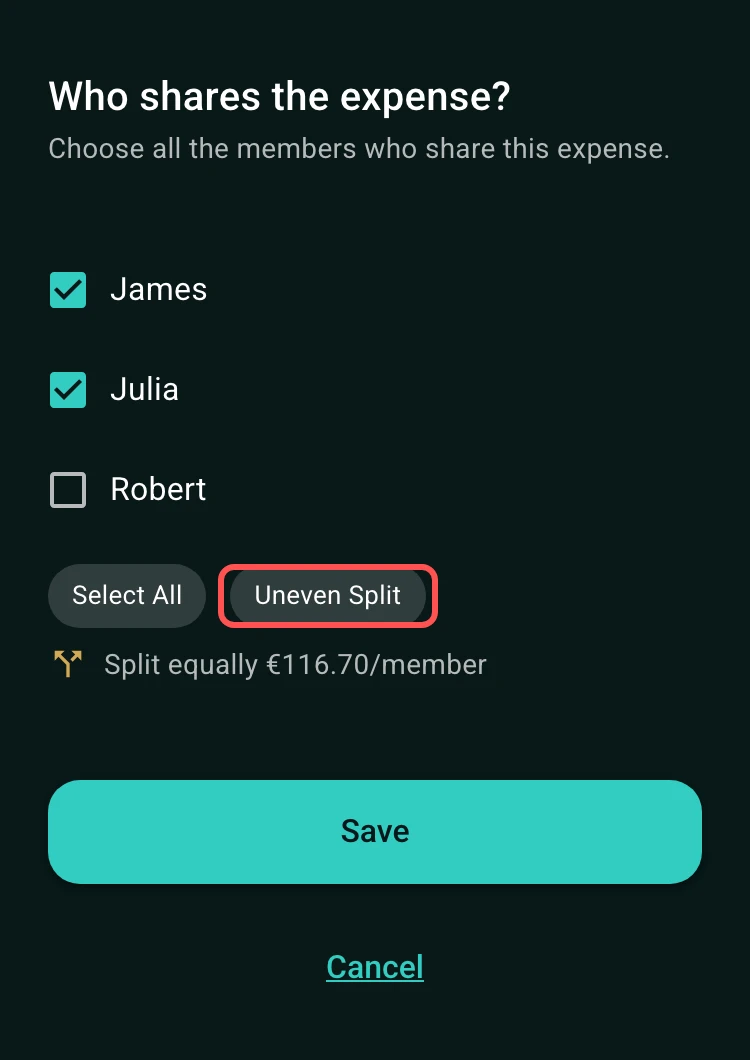
If some individuals consume more than others, a percentage-based split lets the group agree on a defined contribution ratio. A custom amount is better when the exact numbers are already known, such as different meal orders, room prices, or someone joining only part of a trip. Both methods are more accurate than an equal split when participation is uneven.
Pros
- Fairer for unequal consumption
- More accurate for certain situations, like ordering à la carte
Cons
- Requires more time to calculate
- Can be confusing if the bill includes tips or tax
3. Usage-Based Split
This method works best for bills where consumption is clearly measurable, like utilities or subscriptions. Each person pays based on how much they use, which can be the most equitable option.
Pros
- Most accurate for bills based on usage (like electricity or internet)
- Ensures fairness for services where usage is tracked
Cons
- Can be difficult to calculate if usage isn't easily measured
- Requires good record-keeping
Include tax, tips, and rounding consistently
For a restaurant bill, agree whether tax and tip are shared equally or added in proportion to each person's order. Check whether a service charge is already included, then use the SplitMyBills tip calculator before adding the final amount to a shared expense sheet. Decide how to handle a one-cent difference after dividing the total so the final amounts still add up to the receipt.
Choose the Right Method for You
Use an equal split when the group benefits similarly, a percentage or custom split when contributions differ, and a usage-based split only when the measurement is clear. Create a free SplitMyBills expense sheet to record the payer, participants, and final balance. For household bills, see the roommate bill splitter guide or the group vacation expense guide.
Updated Aug 9, 2026